
Jurassic Park and sound
En diskussion på Zoetrope filmforum, januari 2001 kring medlemmen David Morrisons uppfattning om att blandningen av ljud och bild i experimentella och alternativa filmer skapar mer intrikata tolkningar och tredjemeningsstrukturer än klassisk Hollywoodfilm. Jag hade precis skrivit min C-uppsats i filmvetenskap om filmljud och kognition så mitt engagemang var lite förhöjt om man säger så.
Här är mitt svar:
”As you mention, if the sound is just there to describe the image in a non-contrapunt way, there’s not likely to be any extensive, elaborative, third meaning association in works. But that also depends on what one means with such associations.
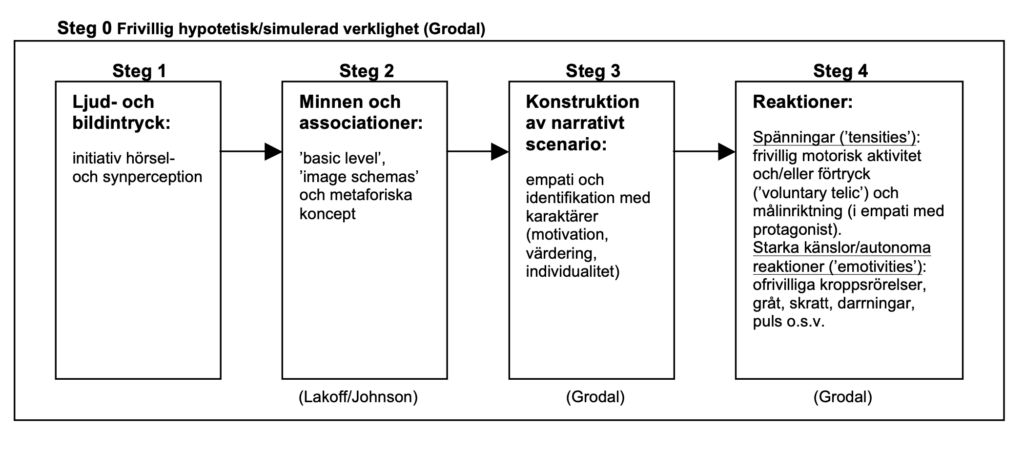
Most of Hollywood movies out there are using the descriptive method; a method you could call ”realistic”. That is, a use of sound and image that triggers such ”image-schemas” in the film-viewer (sets of experiences, connected to the body and its perceptual apparatus) that is connected with more common experiences of the non-filmic world (ordinary, real events). But, it also triggers hypothetically created events in the sense that the events are not actually physically experienced, but instead combined and built using a mix of different memories and experiences within the frame of human belief.
The reason, I believe, that Hollywood movies are so successful in their presentation of the descriptive, ’realistic’ sound and image combinations, is that they are quite well crafted. They sound and look like they could be the real thing, and that makes them attractive. Jurassic Park has dinosaurs in it, which doesn’t exist as living creatures in our life. But by constructing the sound and image so particularly in accordance with our pre-conceptual structuring of experiences, the film allows the viewer – more or less automatically – to trigger different conceptual and transferred ’image-schemas’ based on previous experiences: thundering sound = heavy weight; high and low pitched screaming = threat or empathy for dinosaur or children (depending on situation and viewer bias), along with pre-learned shapes and images of dinosaurs from books, films etc.
If the Hollywood filmmakers hadn’t been so aware of the power of sound in this case, and hadn’t been able to present the sound as realistic (even though, from an objective view, it isn’t: dinosaurs don’t exist. But what is realistic? Isn’t fantasy and imagination a crucial, almost must have, part of of real life?), we as viewers would have thought of the movie as strange, off-beat and bad.
So descriptive, to the image non-contrapunt sound doesn’t have to be less expressive than more freely allowed associated sound-image combinations. It all depends on what you want to achieve in one particular movie. To seamlessy blend image and sound and to thereby simulate an alternative, hypothectical reality is to me as much an art form, and as exiting, as more experimental forms of cinema.
One could say that the third meaning you want David, could be those actually highly creative image-schemas a viewer activates during a well crafted Hollywood movie. Third meanings could also be those other – perhaps more individual and close – memories and experiences that get activated within more loosly connected image-sound combinations. Films which do that tend to be described as art more often than those activating more physical and direct cognitive schemes. I for one wont make that separation.”
Latest comments